

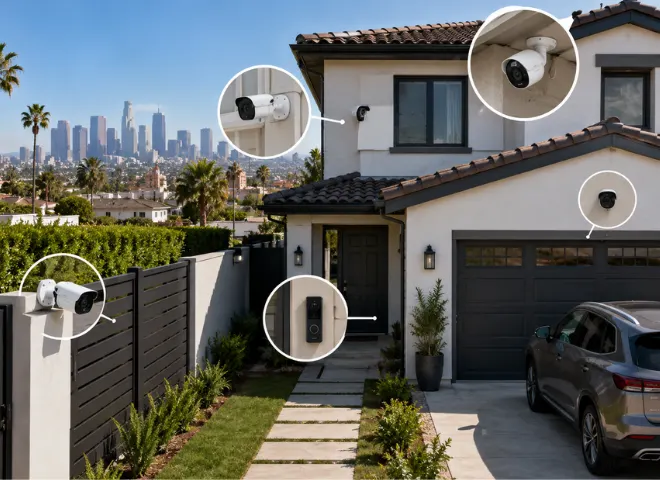
Security cameras are a great way to keep your home safe and secure in Los Angeles.In Los Angeles, the use of security cameras is an excellent method of ensuring the safety and security of your home.
Be honest, most people purchase a security camera, mount it over the front door and assume they’ve got it all covered up. I get it. It seems like all the more. However, if you ever got up close and personal with what a camera can and cannot see, you’d find that there are a lot of blind spots that are wide open.
Los Angeles is a large city and there’s a concern about property crime in many neighborhoods. The fundamentals of home security remain the same, no matter where you live, in the Valley, South LA or on the Westside. It’s not so much how many cameras to purchase, it’s where to actually place them to do something useful.
Based on most home layouts and the most common break-in locations, here are some of my suggestions.
Start With the Entry Points , All of Them
These are all areas that require covering front door, back door, side gates. Burglars that break windows aren’t going to do so in broad daylight. They head towards a door, see if anyone’s there and attempt a kick-in or a basic push. A camera above or next to each outside door means that you’ll get a face shot and a date on the recording. The video is really very important, not only for the police, but for your own sense of security.
Don’t overlook the side door because it is not as noticeable. That is frequently the reason why a person would attempt it.
A house featuring windows that DO NOT face the street.
This is a one that’s missed out on the mark many times. Windows on an alley side, side yard or back garde are more difficult to see from the street and are more attractive targets. Here you have two choices either install an outside camera above the window, set it facing downward or install an interior camera facing outside through the window. Whatever the case, you should have something to cover those spots – particularly at night.
Your Driveway and Garage
Until a car accident, people can’t remember about the driveway. However, your driveway is also the first footway that someone steps down on before he or she gets to your door! The spill is caught early with a camera atop the garage or driveway. You will be able to see a person even before they get close to the house, giving you time to react, or at least an idea of what occurred.
The living room and bedroom make up the interior of the House.
Initially, they feel a bit awkward in the house, but they do have a function. Once someone infiltrates the home, the living room and master bedroom are the rooms they tend to go to, and that’s where most valuables are stored. Those rooms all have a small camera in them, so that there is a second layer of documentation. It’s not to be used for surveillance’s sake. It’s about having something to show when you need it.
Staircases, balconies and basement entries offer a wide variety of potential design opportunities.
This is important if you have these in your home. Balconies are climbable. Basement doors are frequently not as sturdy or noticeable. Stairwells also link floors and provide corridors for movement. A camera mounted at the bottom or top of a staircase or even directed towards a balcony door will provide you coverage of movement between levels which you would otherwise miss.
What is the best angle, and the best height for mounting?
A minimum of nine feet off the ground is a good rule for outdoor cameras. At a height that prevents easy grabbing or breaking, but not so high that the angle cannot be utilized. Adhesive mounts seem like handy options, but tend to fall apart over time, particularly in warm climates; screw them straight into the wall.
Many are embarrassed to write the word angle. When set up directly over a doorway, a camera will capture the top of a person’s head the majority of the time. Not very useful for identification purposes. The camera should be positioned off-center to the side, a few feet from the door, and angled slightly towards the door. The face and body will be more visible that way.
Don’t worry about concealing your cameras. People don’t even try in the first place when they know that the camera is there. This is a functionality that should be retained.
Wi-Fi Signal , Don’t Ignore This Part
Wireless cameras may be handy, but they require your home’s wireless network. A camera in a dead zone is not taking a picture of anything useful. Walk around with your phone, and note the signal strength in each location before making the final choice as to where everything will go. Corners of the house, near to thick walls, garage ceilings, etc. are common weak spots.
When the signal is weak, you have two options – either move the camera to a better signal spot or buy a Wi-Fi extender. 2am is the time you don’t want your camera offline. Sorting out is better before than after installation.
Putting It All Together
Home security does not need to be hard to do, but it does require thought to do. Each camera films one side of the scene. You’ve got several cameras, and they’re positioned to cover the entire property. If you’re not sure where to begin, let a security camera installer in Los Angeles help you determine what works best for your exact home setup and ensure you don’t overlook anything.
Don’t rush the planning. If a camera is in the wrong place or in the wrong direction, it can lead to a false sense of security. When done correctly, it allows you to get the real thing.