

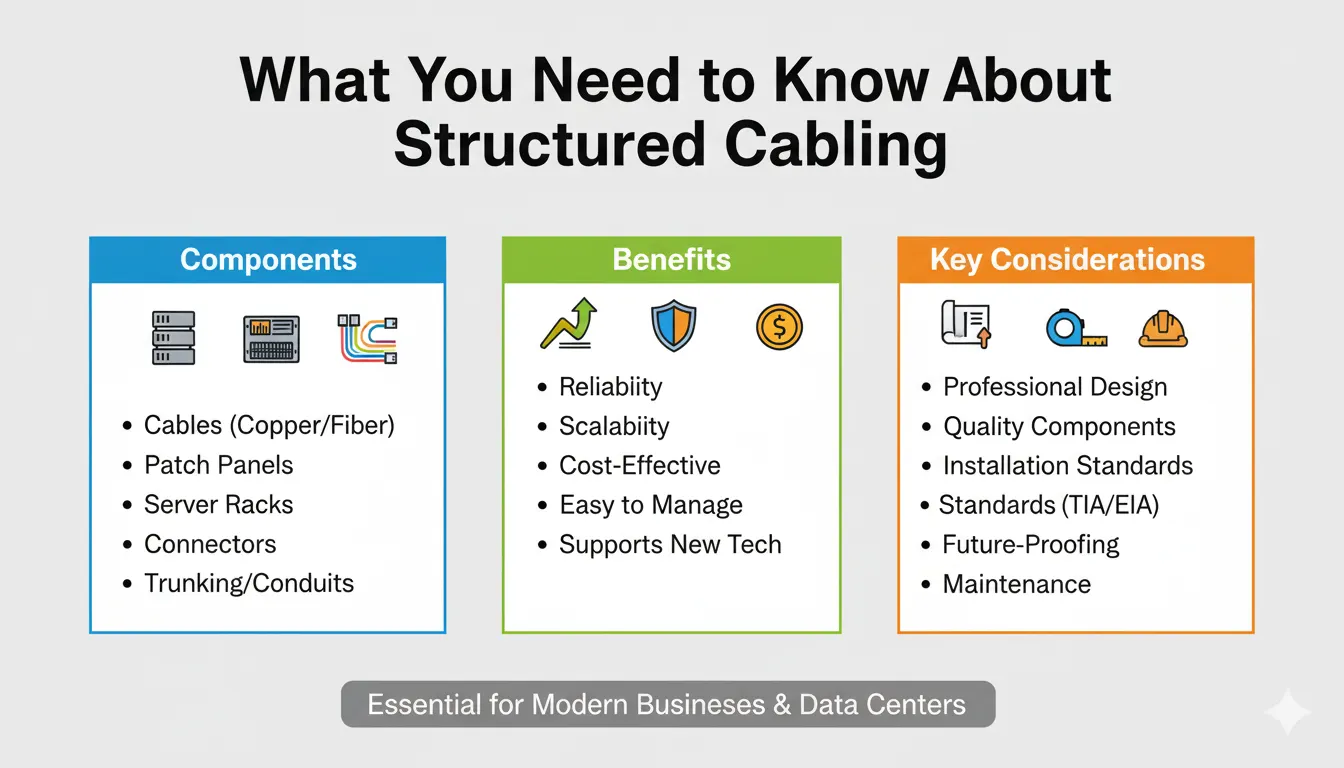
Every company relies on a trustworthy and effective network in today’s rapid digital world. Whether for daily communications, data sharing, or security systems, structured cabling supports your company’s IT foundation. Knowing structured cabling will enable you to create a wiser, more linked workspace at First Digital Surveillance. In this blog, we will understand what you need to know about structured cabling.
What Is Structured Cabling?
A universal framework of cables, connections, and associated equipment, structured cabling offers a complete telecommunications backbone. Structured cabling provides a tidy, ordered, and scalable alternative, far better than conventional wiring, which can get you confused. In essence, it links different equipment like computers, phones, security cameras, and other devices effectively to your network.
Why Structured Cabling Is Important for Your Business?
Investing in organized cabling is about future-ready, performance, and reliability, not just nice wiring. This is the reason it is important:
- Better organization: Simplifies troubleshooting and lowers downtime through improved organization.
- Scalability: Enables simple device addition or removal as your company develops.
- Faster speed: Speeds faster than usual, facilitating better communication by enabling high-speed data transfer.
- Cost-effective: it is more cost-effective, reducing the maintenance costs by a big margin.
A well-planned, structured cabling system ensures your network runs smoothly, whether you are setting up a new office or upgrading an already installed system.
The Key Components of Structured Cabling
Understanding the major and key components of a structured cabling system lets you see how it all interacts:
- Entry Facilities: The location where your internal network interacts with that of your service provider.
- Equipment room: Houses servers, switches, and network hardware in the equipment room.
- Backbone Room: Connects gear rooms with telecommunication through backbone cabling.
- Horizontal Cabling: Horizontal Cabling Links discrete outlets or appliances inside a building.
- Work Area: Comprises user equipment, patch cables, and network connections.
Benefits of Professional Installation
Selecting a certified installer like First Digital Surveillance guarantees your organized cabling fulfills industry standards. A qualified crew will:
- Use fiber optic, Cat6, or Cat6a cables of high caliber.
- Adhere to TIA/EIA standards for design and safety.
- Label and examine every connection.
- Make arrangements for expansion over time.
This strategy guarantees a system that is efficient, strong, and simple to upgrade, therefore saving you time and money over time.
Pro Tips for Maintaining Your Structured Cabling System
Keep these expert pointers in mind to maximize your structured cabling investment:
- Labeling: Label everything precisely. This simplifies future upkeep.
- Cable clutter: Steer clear of cable messes. Use racks and trays appropriately.
- Frequent inspection: Plan on regular inspections. Stop difficulties before they bring about downtime.
- Expansion plan: Select cabling for your future bandwidth requirements.
- Expert installer: Qualified installers guarantee quality and maintain high standards of safety; therefore, engage experts.
Final Thoughts
Structure cabling is the base of a robust, safe, and future-proof networking. First Digital Surveillance is a locally built company in Los Angeles. They do better planning and installation for different organizations, to help your company have continuous internet access and effective communication systems for years to come. So contact us for better cable installation service and make your company’s future secure.
FAQs:
Question: What is structured cabling?
Answer: The foundation of an organization’s communications and data networks, structured cabling is a systematic arrangement of cables and devices.
Question: Why is structured cabling important for businesses?
Answer: It guarantees quick, dependable, and well-arranged network connections that help growth, scalability, and minimize downtime.
Question: What are the main components of a structured cabling system?
Answer: Significant components comprise entry facilities, equipment rooms, backbone cabling, horizontal cabling, and work stations.
Question: How does structured cabling improve network performance?
Answer: It helps several connected devices effectively, streamlines troubleshooting, and allows high-speed data transfer.
Question: Why should I hire a professional installer?
Answer: Certified installers help the system satisfy safety and performance criteria, therefore lowering future maintenance expenses.
Question: How can I maintain my structured cabling system?
Answer: Plan for future network development, label cables, stay organized, and schedule routine inspections.