

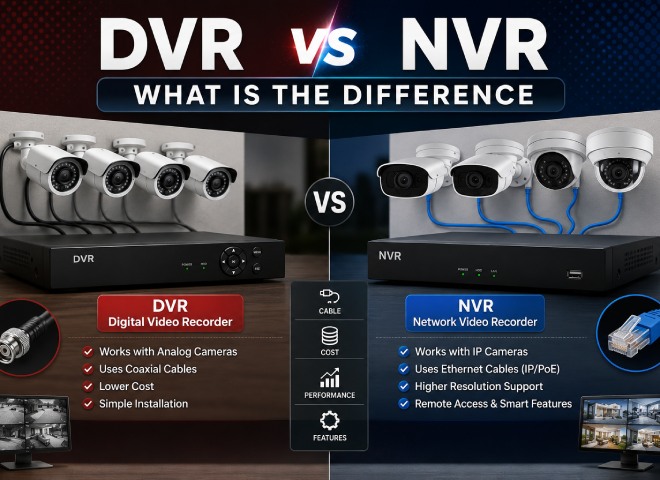
When it comes to selecting a security camera system, making a decision between a DVR and an NVR is not an easy task for the residence and business owners. Though both devices are used for the purpose of video recording, storage and managing the recorded video from surveillance cameras, they still use totally different methods to complete this task. But still customers are curious to know about the difference between a DVR and an NVR system? In short words, DVR stands for digital video recorder and NVR stands for network video recorder, one word with analog CCTV camera and another one used with IP CCTV camera.In this blog, we will know about the features of DVR and NVR and will try to understand the difference between the both systems.
What Is a DVRSystem ?
DVR is one of the popular devices employed with different types of analog CCTV cameras. Generally, in a DVR protocol recording system, the cameras generate the video signals, which are then transmitted to the DVR through the coaxial cable. Then, the DVR encodes the video and saves it into the hard disk. Following are the diagram of the traditional DVR system:
Analog CCTV – Coaxial Cable – DVR – HDD – Screen
DVR systems have gained popularity among private home owners, retailers, manufacturing enterprises, and other users.
Advantages of DVR
One of the best benefits of using a DVR system is its simplicity. If an analog CCTV system already exists, the upgrade to a DVR can be very cost-effective compared to completely replacing the system itself. Furthermore, DVR systems offer local recording with a degree of reliability and are available in a range of price structures.
Drawbacks of DVR
One of the biggest drawbacks of a DVR system is that it is mainly designed around analog cameras and the installation is also very difficult sometimes. The system is quite limited in terms of expansion or upgrade potential.
What Is an NVR?
NVR refers to a Network Video Recorder. It is different from a DVR, which is made for working with analog cameras. Analog cameras traditionally capture video footage and send the video to the DVR for recording. In the case of an NVR, the video from the cameras is sent to the NVR for saving on the hard drive. The NVR can receive signals from the cameras through a network in the following manner:
IP Camera – Network/Ethernet – NVR – Hard Drive – Monitor
Most NVR systems operate by using Ethernet cables, but some systems can also take advantage of Power over Ethernet (PoE), which means that the camera’s cables are responsible for the communication and power supply of the camera.
Advantages of NVR
The reason why NVR systems are so widely used is due to their compatibility with advanced IP cameras as well as the fact that they allow for efficient high-definition recording. Depending on the type of camera, NVR systems may also detect motion, people, and vehicle detection through features such as two-way audio, night vision, and other smart features. The other advantage of NVR systems is that they offer flexibility in the connection of IP cameras through networks, which makes them applicable in larger and more sophisticated surveillance systems.
Drawbacks of NVR Systems.
Though NVR systems present a great deal of benefits, they can still be costly in the beginning since the IP cameras and network equipment are more expensive than traditional analog devices. In addition, working with IP cameras requires a certain knowledge of how networking works, especially where large systems with advanced device access capabilities are concerned.
What Is the Main Difference Between DVR vs NVR?
The main difference between the two systems is where the processing of the signals occurs. In DVR systems, the video signals are transmitted from the analog camera to the DVR for processing and recording. However, in NVR systems, the video signal is processed by the IP camera, and the resulting digital video is transmitted to the NVR through the network. This distinction impacts several aspects of the two systems, such as the variety of cameras used, cables used, installation process, video quality, and flexibility.
DVR vs NVR Comparison Table
| Feature | DVR | NVR |
| Full form | Digital Video Recorder | Network Video Recorder |
| Camera type | Analog CCTV cameras | IP/network cameras |
| Video signal | Analog | Digital |
| Video processing | Mainly handled by DVR | Mainly handled by IP camera |
| Common cable | Coaxial cable | Ethernet/network cable |
| PoE support | Usually not native | Common on PoE NVRs |
| Video quality | Good to high, depending on system | Generally high and highly scalable |
| Installation | Simple for traditional CCTV | Flexible for network-based systems |
| Advanced features | Available on some systems | Common with modern IP cameras |
| Scalability | More limited | Generally more flexible |
| Best suited for | Existing analog CCTV | New and modern surveillance systems |
DVR or NVR, Which Is Better for Home Security?
There are advantages to both choices when it comes to home security. If your current CCTV setup uses traditional coaxial cabling and you are looking for an upgrade, then the DVR is your best bet. If you are doing a new installation and would like to utilize high-definition IP technology with the ability to extend your system in the future, the NVR would be the better option.
DVR or NVR, Which System is better for businesses?
NVR is a superior option for companies because of its ability to work with IP cameras. Many organizations require cameras for office premises, entries, parking lots, storage spaces, shops, and other open spaces. Being able to use a network-based NVR will make a business’s surveillance system installation and growth process easier.
Which One Should You Pick?
Which device is better will depend on several factors such as what you need for now and in the future. If you have an analog CCTV system already, then choosing a DVR can still work for you economically while still making it easy to implement changes. On the contrary, if you are developing a new project, an NVR is likely to be a better option because it utilizes IP cameras and can provide more possibilities. To make it more simple, use a DVR for traditional analog systems and existing infrastructure, while an NVR is used with modern IP cameras.
Conclusion
The debate regarding DVR vs NVR revolves around what kind of surveillance system you require. If you own an older analog CCTV system, a DVR is a perfect solution. If you have IP cameras, an NVR is better because it has more features and options and allows for greater flexibility. If you have an existing analog CCTV system, then the DVR is definitely the more affordable option to go with. If you want to install a modern system to take advantage of the newer technology, you should choose the NVR. but make sure to take the services of a professional team especially in Los Angeles, and there is no one better than the FDS Security camera, because we never compromise on quality and reliability.